

Corrupt
When you think of the term ‘corrupt’, what comes to mind? Perhaps criminal, illegal, immoral and unethical activity. You wouldn’t necessarily be wrong, but I believe we need to broaden our understanding for a more meaningful interpretation and application.
Think of the hard drive in your computer. These days, they are most likely solid-state drives (SSDs), which means they have no moving parts, are silent, and more closely resemble memory chips (RAM). However, you may still have a hard disk drive (HDD), which is mechanical, and you can hear it when it is reading or writing data. When the disk becomes damaged and data is inaccessible, the disk is ‘corrupted’. When the disk is corrupt, it means it is broken in some way and no longer able to do what it was made for. This points to a definition we too often overlook.
When we look at institutions and label them corrupt, we generally mean something sinister, but we also need to think of them as broken and no longer able to do what they were made for or set up to be. We do, but too often as something separate from being corrupt, instead of being part of the corruption. We see corruption as stemming from evil, rather than evil stemming from what is corrupt—broken.
Why is this distinction important? Because it changes us and how we engage with the world.
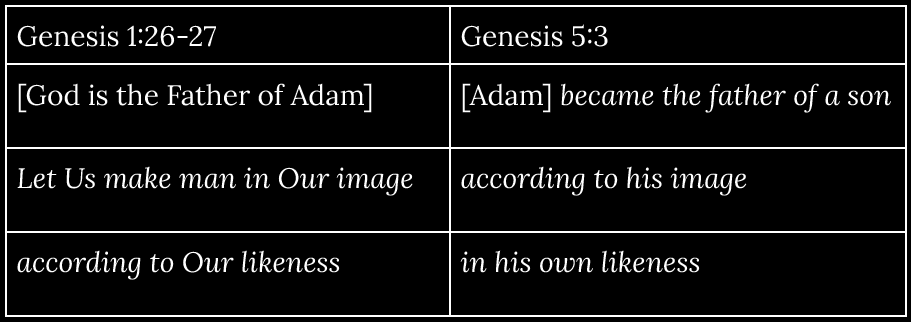
In Genesis 1:26, God said, “Let Us make man in Our image, according to Our likeness”. Then, in verse 27, “God created man in His own image, in the image of God He created him; male and female He created them.” In Genesis 3, we have the fall of humanity, and so, through being removed from God’s presence, the image of God in humanity becomes corrupt. Yes, evil takes its place in the human heart, but as a result of corruption—a broken humanity that is no longer able to do what it was made to do.
From here on, humanity is centred on establishing its own image. In Genesis 5:3, it says that Adam “became the father of a son in his own likeness, according to his image, and named him Seth.” Look at the parallels with Genesis 1:26:
This continues as we see later how Israel wanted a king (other than God) just like other nations (1 Samuel 8:4-5), and how kings build statues that pointed people away from God and to their own likeness, in some way. While the image and likeness of God is about creation, life and goodness, the image and likeness of a broken (corrupt) humanity is the opposite. When something is corrupt (like data on a hard drive), the original is there, and we can catch glimpses of it, but the original is irretrievable without external intervention. Without help, we are without hope; the image and likeness of God in everyone is corrupted, and we are separated from our eternal place with Him.
If we cannot help ourselves, what can we do to restore what has been corrupted? Thankfully, the image and likeness of God has been preserved. When God brought Adam into the world, He created a template for humanity to remain whole in God’s presence. When the template Adam carried was corrupted, God sent into the world a second (Last) Adam who was/is the complete and uncorrupted template. The first was raised from the earth, the second sent down from heaven (1 Corinthians 15:44b-49). This is the Son of God, incarnate in Christ Jesus. “He is the image of the invisible God” (Colossians 1:15), “the radiance of His glory and the exact representation of His nature” (Hebrews 1:3).
As an aside, an ‘image’ can be taken of a hard drive in its complete form and stored somewhere, so that should the drive become corrupted, it can be restored from the uncorrupted stored image.
The hope we have is in His capacity to restore the image and likeness of God in us. Like clay in a potter’s hands (Jeremiah 18:6), He remoulds us and conforms us “to the image of His Son (Jesus Christ)” (Romans 8:29). This remoulding, conforming, is the process of “being transformed into the same image [of God] from glory to glory” (1 Corinthians 3:18), and becoming a new creation (2 Corinthians 5:17) in the Potter’s hands. The old self has been corrupted, but the new self is who we are in Christ, the likeness of God, created in righteousness and holiness (Ephesians 4:22-24).
Back to the distinction I started with: perhaps we are wrongly seeing corruption as stemming from evil, instead of evil stemming from what is corrupt. James acknowledged in 3:9 that we “have been made in the likeness of God”. Out of the corruption of that image, we are broken and unable to fulfil what we were made for, and from there come corrupted thoughts, words and actions. Something (or someone) that is corrupted is a victim of its (their) broken state. Don’t mistake this as excusing the evil that we see, experience or inflict, but we shouldn’t take a sledgehammer to a broken computer because it can no longer fulfil its purpose! We tend to condemn that which is broken and throw it away. Including people.
However, consider the potter: “the vessel that he was making of clay was spoiled in the hand of the potter; so he remade it into another vessel, as it pleased the potter to make” (Jeremiah 18:4). What is broken, corrupted, can be saved. In terms of things, we can fix, get new parts or recycle. In terms of people, they can be made new because there is an image worth restoring, and there is One (and only one) who can restore it.
Ephesians 6:12 says, “our struggle is not against flesh and blood”. We are not to take the proverbial sledgehammer against what is broken, what is corrupted, just because people can no longer fulfil their purpose. Instead, we take it (the sledgehammer) to what exploits the corruption: against “the rulers, against the powers, against the world forces of this darkness, against the spiritual forces of wickedness in the heavenly places.”
The institutions of our land are broken (corrupt) because their creators are broken (corrupt). Battling against the people will not result in fixing what is broken. Battling against the institutions will not result in fixing what is broken. The weapons we have are spiritual, which means the battle is spiritual; and the sinister purpose isn’t simply to destroy humanity but more intentionally to rise up against any knowledge of God (2 Corinthians 10:3-5). In other words, to prevent the restoration of the image of God in humanity.
Remembering what and where the battle is, and who it is against, equips us to fight the true enemy—the one who seeks to take what is corrupt and manipulate it to his own ends as an act of rebellion against God. The weapons we have been given are for that purpose. The rest of our equipping is to bring what is corrupt to the One who is able to restore the original image.
We have a great and wonderful job to do!